The Train That Never Stops
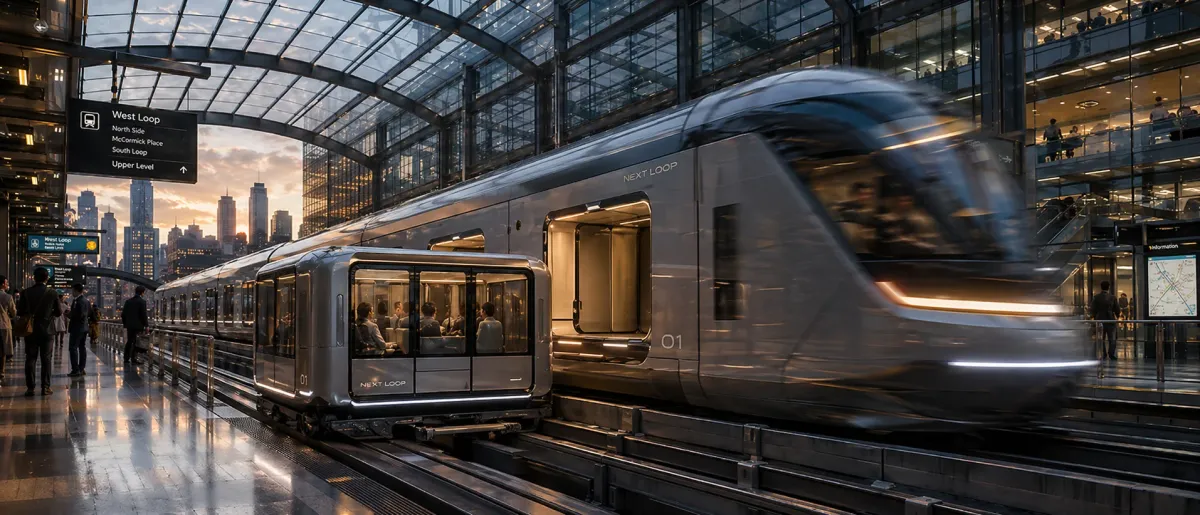
What if stations became launch bays?
Imagine you are standing on a tram platform.
The tram is coming.
Normally, this is the part where the tram performs its little urban ritual:
- Screech into the station.
- Stop completely.
- Open doors.
- Let 47 people decide whether they are getting in, getting out, blocking the door, checking Google Maps, or rethinking their life.
- Close doors.
- Ding.
- Accelerate again like a tired elephant.
Now imagine something else.
The tram does not stop.
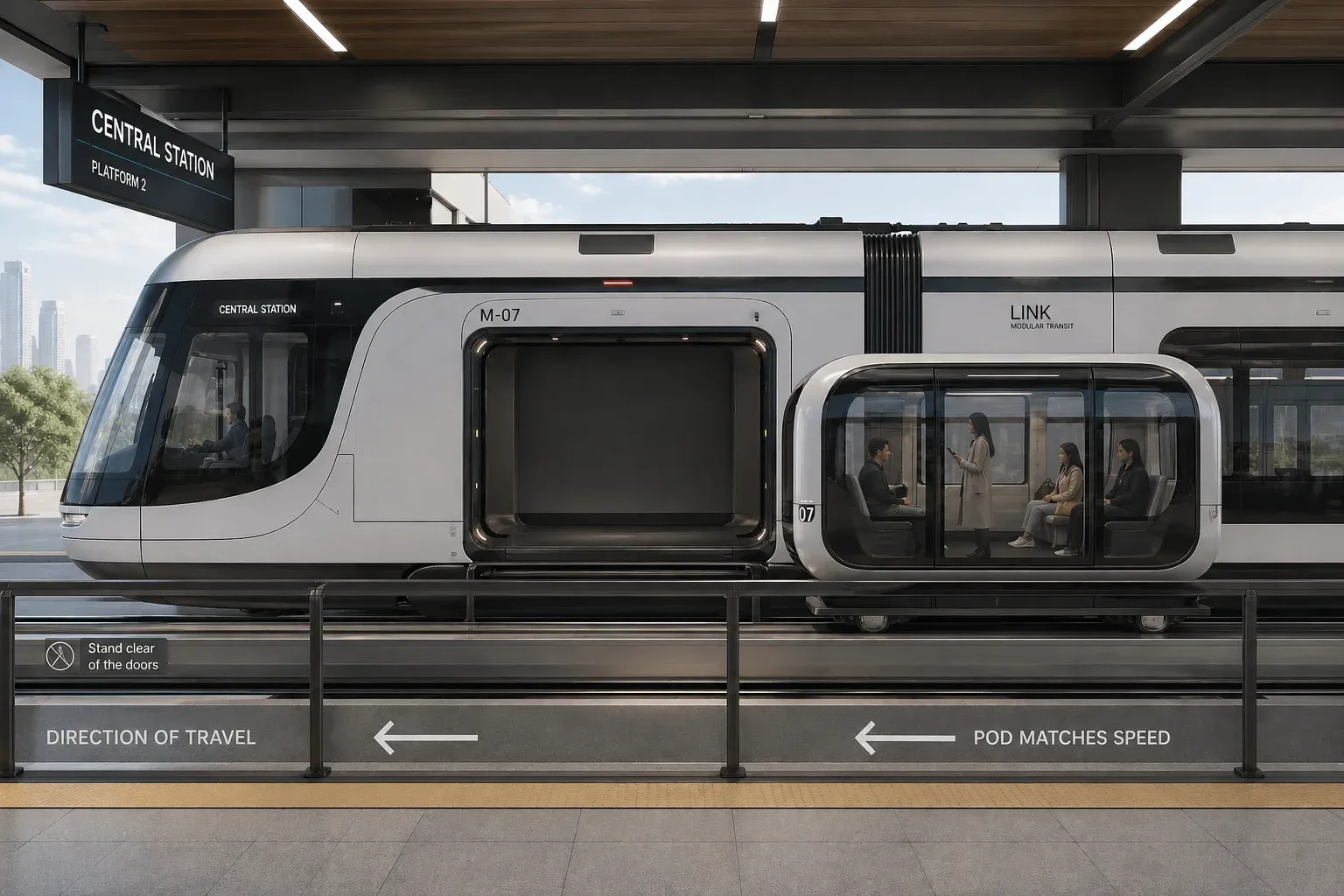
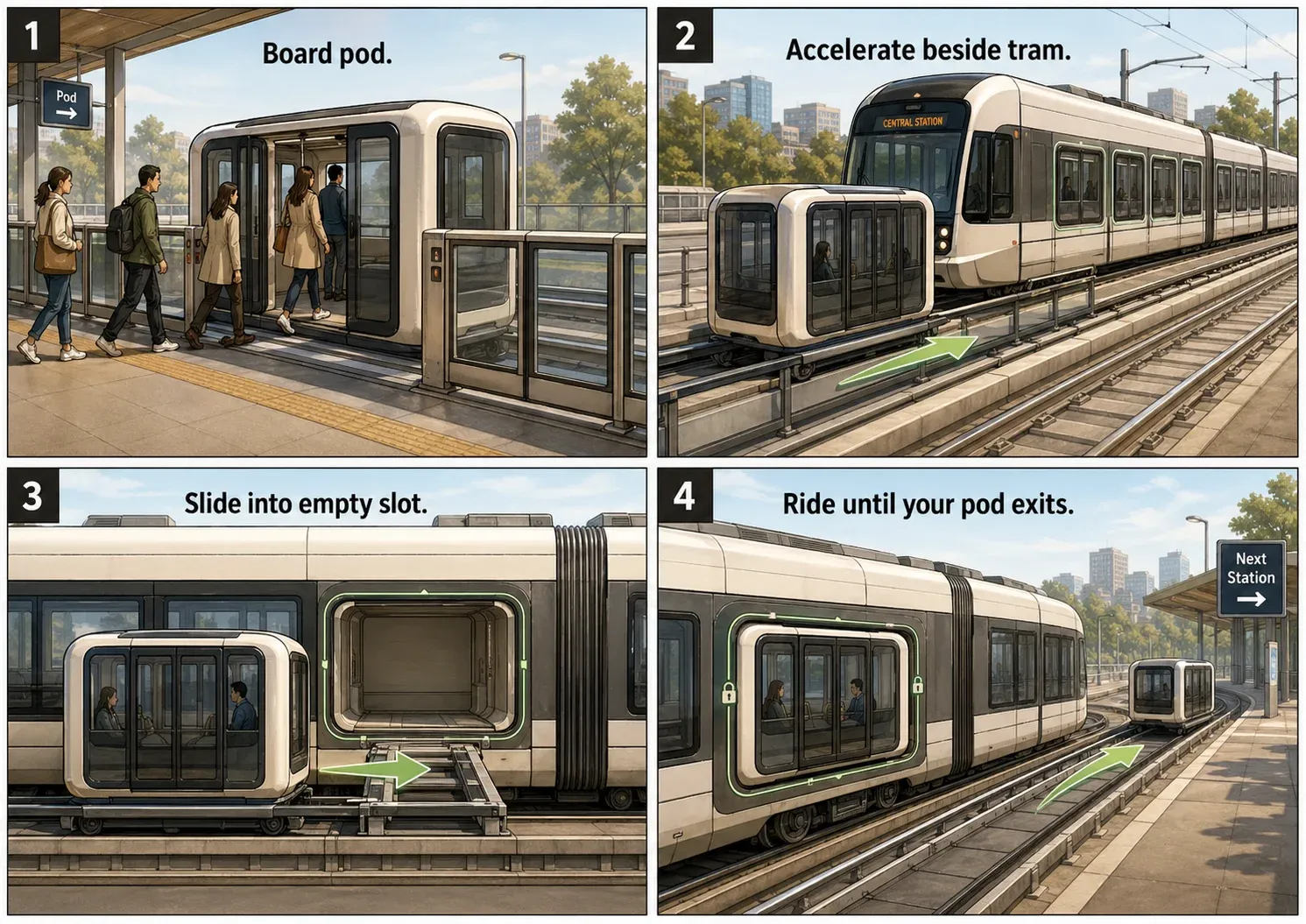
Instead, beside the track, a small passenger pod begins moving. You are already inside it. You selected your destination when you entered, like choosing a floor in a futuristic elevator. The pod glides forward, faster and faster, until it matches the tram’s speed.
Then, in one smooth sideways motion, your pod slides into an empty slot on the tram.
Click.
Locked.
You are now part of the tram.
Behind you, another pod quietly slides out of the tram and onto a braking lane, carrying passengers who are arriving at this station. They slow down separately. The main tram never stopped. It merely dipped its speed, swapped pods, and kept going.
This is the basic idea:
What if trains did not stop for passengers — but passengers joined them at speed?
The hidden villain of public transport: stopping
Trains are usually discussed in terms of top speed.
A tram can go 70 km/h.
A metro can go 80 or 100 km/h.
A high-speed train can go 300 km/h.
But your actual experience as a passenger is usually not “Wow, this train’s maximum velocity is impressive.”
It is more like:
“Why are we stopping again? We just stopped.”
Urban rail has a secret enemy: station penalty.
Every station costs time in several ways:
- braking into the stop
- waiting with the doors open
- passenger chaos
- door closing
- accelerating back to speed
The official-sounding term for the door-and-passenger part is dwell time. It is the time a vehicle spends sitting at a station so people can board and leave. Dwell time can be only a few seconds at a quiet stop, but on crowded routes it becomes one of the big reasons the whole system slows down.
And dwell time is sneaky. One stop is not the problem. One stop is fine. One stop is charming. One stop is a little pause.
But ten stops?
Now the tram has spent several minutes pretending to be a building.
A 2020 rail dwell-time study describes dwell time as a major component of station operations and points out that it depends on door operations, boarding, alighting, passenger distribution, and other messy real-world factors.[1] A Stockholm commuter-train study also found that higher numbers of boarding and alighting passengers increase dwell-time delays, which is exactly the kind of boring sentence that becomes very interesting when you realize it means “people standing in the wrong place can slow down an entire city.”[2]
So the wild thought is this:
What if the train did not have to pay the full station penalty every time only a few people wanted to get on or off?
The “obvious” solution that is actually insane
The first version of this idea is easy to imagine:
A train keeps going.
A second little vehicle speeds up next to it.
Doors open.
People walk across while both vehicles are moving.
This is the kind of concept that sounds amazing for three seconds and then your brain says:
“Wait. Are we asking commuters to do a Mission: Impossible transfer while holding coffee?”
Even if the vehicles match speed perfectly, you still have to solve:
- moving doors
- air pressure
- safety interlocks
- platform gaps
- wheelchair access
- people panicking
- people hesitating
- people carrying IKEA furniture
- people who try to enter just as the doors close because humanity is a design constraint
For high-speed trains, the problem becomes even more ridiculous. At 300 km/h, a 30-second transfer window would require the moving transfer system to run alongside the train for about 2.5 kilometers. That is not a station. That is a small airport runway with commitment issues.
This is why the better version of the idea is not:
“People move between the train and the pod.”
It is:
“The pod itself moves between the station and the train.”
No moving walkway between vehicles.
No passengers crossing a gap.
No doors opening between train and platform at speed.
The passenger cabin becomes the thing that transfers.
That one change makes the concept much less like a circus trick and much more like infrastructure.
The gondola clue
The best real-world analogy is not another train. It is a gondola.
Modern detachable gondolas already do something that feels suspiciously close to this idea. On the line, cabins move quickly. At the station, they detach from the fast-moving cable, slow down for boarding, then accelerate and reattach.[3][4]
The passenger does not sprint after the gondola.
The gondola does the hard part.
That is the key inspiration.
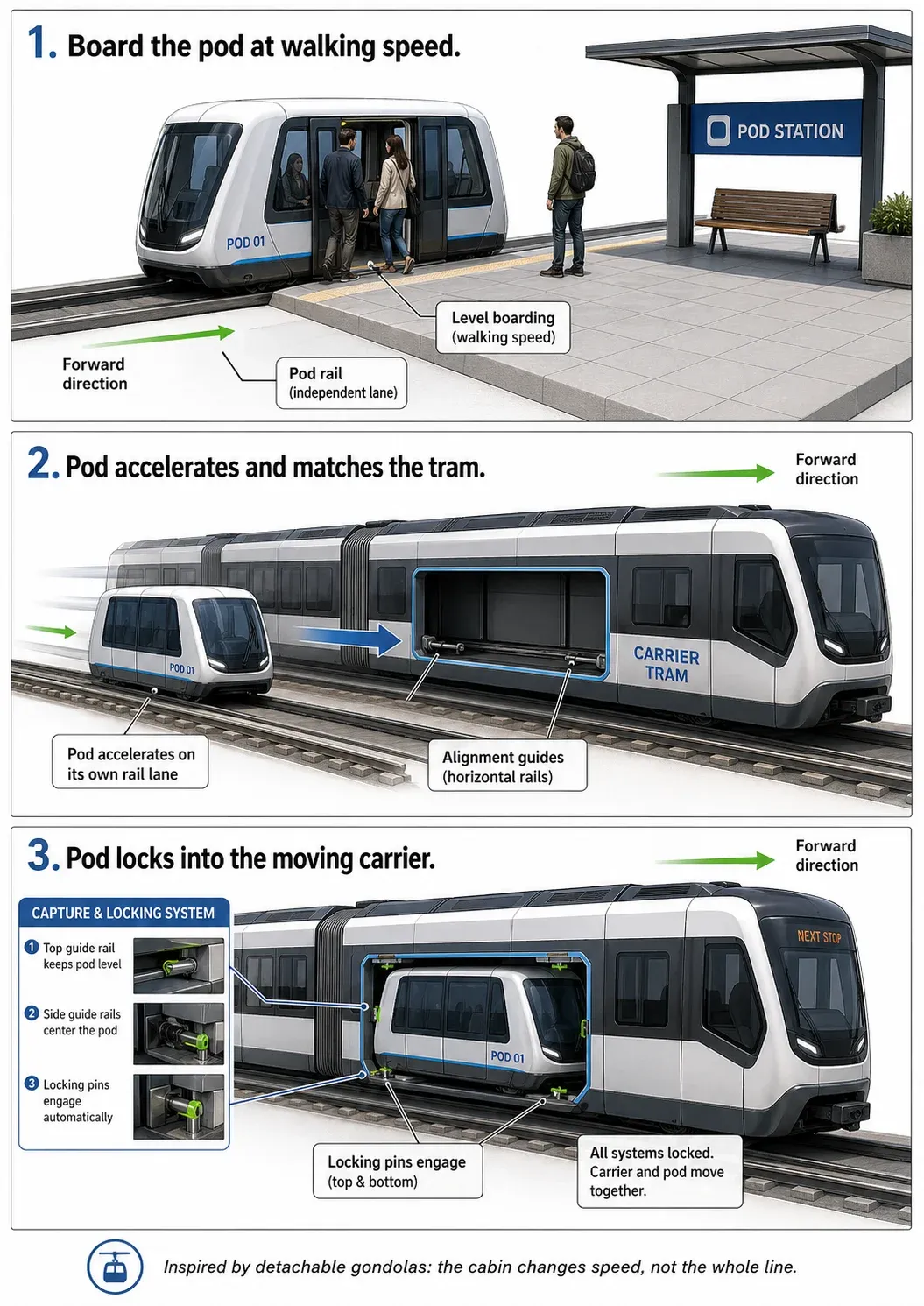
In a pod-tram system, the station would behave like a gondola station turned sideways and made rail-based:
- You enter a pod at walking speed.
- The pod leaves the platform.
- It accelerates on a short side track.
- The main tram slows slightly but does not stop.
- The pod slides into a free slot.
- Another pod slides out and brakes separately.
The main tram becomes less like a vehicle with doors and more like a moving carrier frame.
It is not a train in the old sense.
It is a conveyor belt for passenger capsules.
The best near-future version: the “slow-through” pod tram
The most realistic first version would not be a high-speed train. It would be a tram, light metro, airport shuttle, campus circulator, or exhibition-line vehicle.
Something controlled.
Something moderate speed.
Something with stations close together.
Here is the practical version:
The main vehicle
A long tram-like carrier with several side slots. Each slot can hold one pod. It has motors, power, control systems, and structural strength. It is the “spine” of the system.
The pod
A small passenger cabin, maybe 6–12 people. You board it at the station while it is stationary. It has seats, standing space, accessibility features, screens, emergency systems, and a destination assignment.
The station
Not just a platform, but a pod launch bay. It has:
- waiting pods
- acceleration lanes
- braking lanes
- emergency bypass tracks
- sensors
- locking checks
- a dispatch algorithm
The exchange
The carrier approaches the station and slows from, say, 70 km/h to 50 km/h. It still moves quickly, but not insanely quickly. Outgoing pods slide out into a braking lane. Incoming pods, already matched in speed and position, slide into free slots.
The carrier never comes to zero.
This is the whole trick.
Not “no slowing.”
Not “teleportation.”
Not “humans doing parkour.”
Just never stopping completely.
And that matters because stopping completely is where a lot of time disappears.
A tiny bit of math, because reality is rude
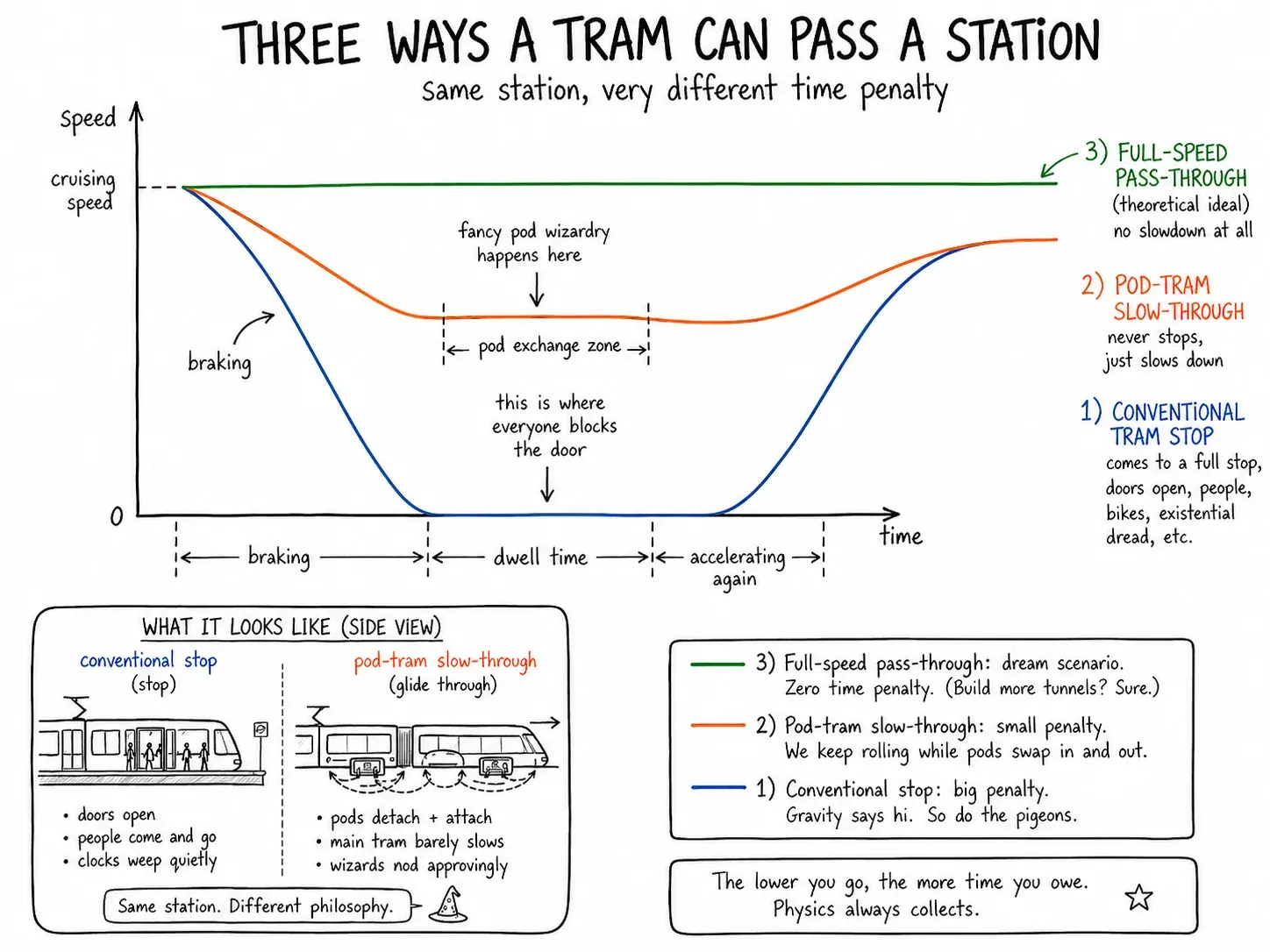
Let’s say a tram normally travels at 70 km/h between stops.
If it stops at a station, it must brake from 70 to 0, wait, then accelerate from 0 back to 70. Even with comfortable acceleration and braking, that alone costs time. Add a typical 25–35 second station dwell, and a single stop can easily cost something like 45–55 seconds compared with simply continuing through.
Now suppose the tram only slows from 70 km/h to 50 km/h through the station exchange zone.
That is a much smaller speed change.
Energy scales with speed squared, which means reducing the pod’s target speed from 70 km/h to 50 km/h almost halves the kinetic-energy burden for the pod launch system.
In plain English:
Slowing the tram a little makes the pod system much easier, while still avoiding most of the time loss of a full stop.
This is the important compromise.
A “non-stop train” does not have to mean “same speed everywhere.”
It can mean “never fully stop.”
That is a much more achievable dream.
Why this is more exciting for cities than bullet trains
At first, high-speed trains sound like the obvious target.
A 300 km/h train stopping at a station loses a lot of time. So shouldn’t we solve that first?
Maybe someday. But high-speed rail is the boss level.
At 300 km/h:
- aerodynamic forces become brutal[5]
- pressure waves matter[6]
- exchange lanes become kilometers long
- safety certification becomes terrifying
- a tiny mechanical error becomes a very large newspaper headline
At 50–70 km/h, the system is still hard, but it enters the realm of “ambitious engineering” rather than “please notify the insurance company.”
Urban rail also has more to gain in a certain way. A high-speed train might stop every 100 kilometers. A tram might stop every 600 meters. The stop penalty happens constantly.
A pod-tram would attack the daily annoyance of urban transit: the fact that a vehicle capable of moving quickly spends much of its life slowing down, waiting, and starting again.
It is not about breaking speed records.
It is about removing the little pauses that add up to an absurd amount of wasted time.
Has anyone tried something like this?
I found no evidence of a commercial system operating in this exact form.
But several related ideas have appeared.[7][8]
There have been concepts for trains that pick up passengers without stopping, including older proposals discussed since the 1960s.[9] A widely circulated roof-pod concept imagined passenger cabins attaching to the roof of a passing train. It looked dramatic, but it also had obvious problems: stairs, accessibility, roof-level transfer, and passenger movement through the train.[10]
A more elegant concept came from PriestmanGoode’s Moving Platforms idea, where local trams would accelerate alongside high-speed trains and dock with them, turning the tram into a kind of moving station.[11]
That concept gets one big thing right: stations do not have to be fixed places where the fast vehicle stops. A station could be a moving system.
But the pod-slot version goes one step further:
Don’t dock two passenger spaces and ask people to transfer.
Dock the passenger space itself.
That is the design leap.
The pod is not a shuttle to the train.
The pod becomes part of the train.
The article’s central image
The whole concept can be summarized in one visual:
A station is no longer a place where a train stops.
It is a place where passenger capsules are launched, captured, sorted, and recovered.
The tram is no longer a tube with doors.
It is a moving backbone.
The pod is no longer a waiting room.
It is your personal piece of the train.
The hard part isn’t moving pods. It’s sorting humans.
A tram that never fully stops.
A station that works like a launch bay.
Passenger pods that slide into and out of a moving carrier vehicle.
No dramatic door-to-door transfer. No commuter parkour. No “please step across this moving gap at 50 km/h while holding soup.”
Beautiful.
But then the concept runs face-first into a problem that every transportation system eventually discovers:
People do not all want to go to the same place.
This is deeply inconvenient of them.
If ten people enter a station, one wants Stop 2, another wants Stop 3, three want Stop 6, one wants the airport, one is lost, two are tourists who think they want Stop 8 but actually want Stop 5, and one is just riding because the pod has air conditioning.
A normal tram solves this with brute simplicity:
Everyone gets into the same big tube. The tube stops everywhere. People leave when it is their turn.
A pod-tram cannot be that lazy. If the whole point is that the main vehicle does not stop everywhere, then the system needs to know where every pod is going and when to detach it.
This means the real invention is not just mechanical.
It is logistical.
The pod-tram is not only a train.
It is a sorting machine for humans.
And humans are basically luggage with opinions.
The destination problem
Let’s imagine a simplified line with ten stops.
At Stop 1, passengers board pods. Some want Stop 2, some Stop 5, some Stop 10.
The naive solution is:
“Easy. Have one pod for every destination.”
This works for about twelve seconds before collapsing into madness.
If every origin station needs separate pods for every possible downstream destination, the system quickly becomes a pod zoo. Pods for Stop 2. Pods for Stop 3. Pods for Stop 4. Empty pods waiting for rare destinations. Full pods for popular ones. Confused passengers. An app. Another app. A screen that says “Platform 3B, Pod 14, Zone Blue, maybe.”
This is how you accidentally reinvent airport boarding.
So the system needs a better trick.
Trick 1: make the station behave like a smart elevator
Modern high-rise elevators often use destination dispatch.
Instead of pressing “up” and waiting for a random elevator, you enter your destination floor first. The system groups passengers going to similar floors and assigns them to the right elevator.[12]
This is exactly the kind of thinking a pod-tram needs.
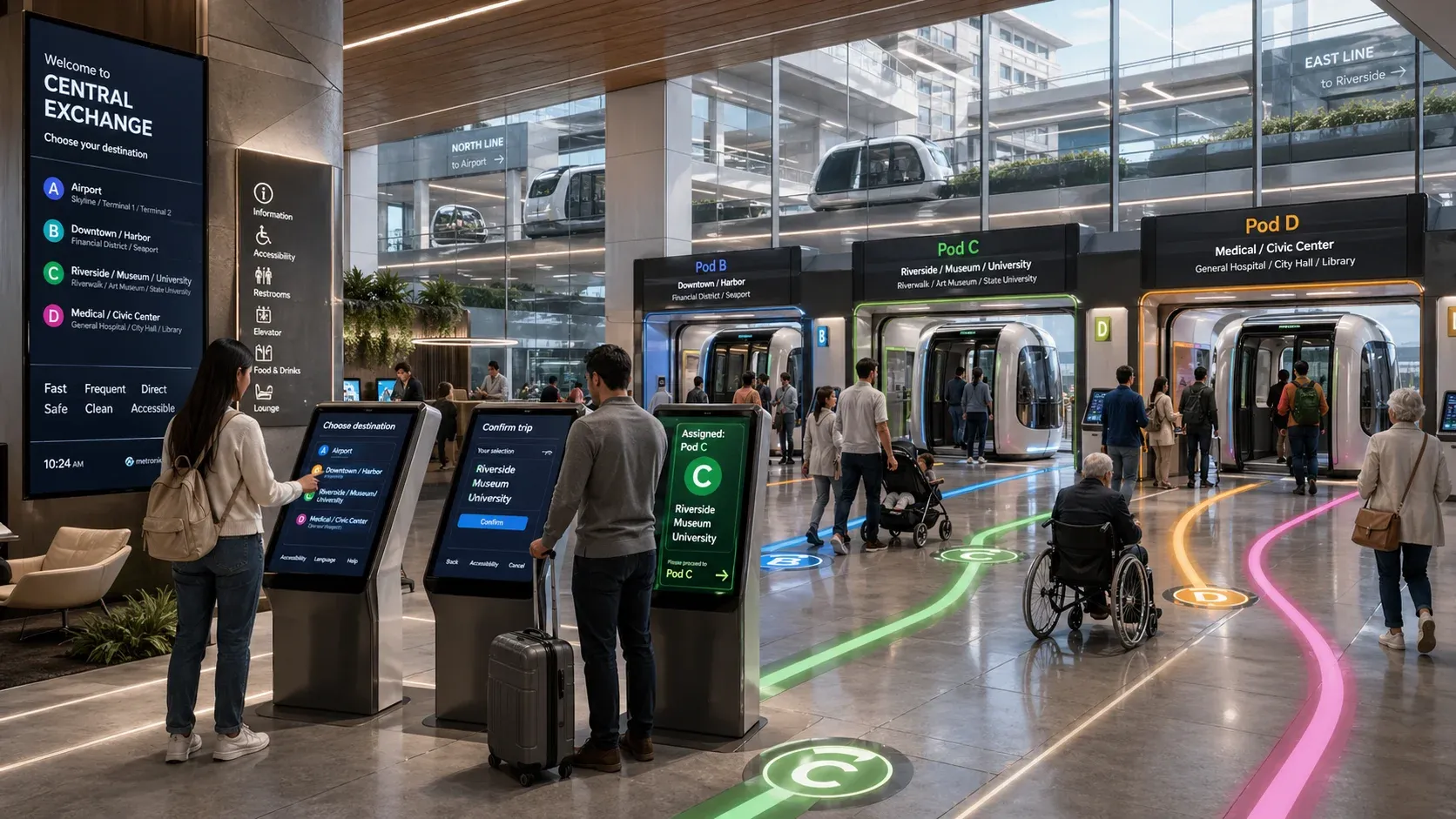
At the station, you do not just board “the tram.”
You select your destination.
The station says:
“Go to Pod C.”
Pod C is not necessarily your private pod. It might be an 8-person pod with other passengers going to the same stop or the same destination zone.
The result feels more like an elevator lobby than a railway platform.
This solves several problems at once:
- Passengers do not need to understand the vehicle choreography.
- Pods can be grouped by demand.
- Popular destinations get more pods.
- Rare destinations can be batched.
- The system knows in advance which pods must exit where.
A conventional tram is reactive: people decide to leave when the doors open.
A pod-tram is predictive: the system knows the exit pattern before the pod ever launches.
That is a huge difference.
Trick 2: stop thinking in stations, start thinking in zones
If the line has ten stations, the worst possible version is ten exact destination pods at every stop.
A better version is zoning.
Instead of:
“This pod is only for Stop 7.”
You use:
“This pod is for the West Zone.”
Then the system handles the finer sorting closer to the destination.
Imagine a line divided into three zones:
| Zone | Stops | Pod strategy |
|---|---|---|
| Inner Zone | Stops 1–3 | frequent short-hop pods |
| Middle Zone | Stops 4–7 | grouped destination pods |
| Outer Zone | Stops 8–10 | larger, less frequent express pods |
For busy stops, exact-destination pods make sense.
For quiet stops, a zone pod makes more sense.
This is already how real transit works in spirit. Express trains, skip-stop services, airport shuttles, and elevator dispatch systems all rely on the same idea:
Do not treat every destination equally. Treat demand intelligently.
The pod-tram just makes that logic physical.
The station becomes a real-time sorting algorithm made of rails.
Trick 3: make pods bigger than you first imagine
The first mental image of this idea might be a tiny 2–4 person pod.
That sounds elegant and personal, like a taxi that got a STEM degree.
But public transport hates elegance. Public transport likes capacity.
A 4-person pod is adorable.
An 8–12 person pod is useful.
The pod should probably feel more like a compact elevator cabin or mini tram compartment than a private capsule. Enough seats for comfort. Standing space for short trips. Room for a wheelchair, stroller, bike, suitcase, or one person with a backpack large enough to qualify as an architectural feature.
A useful pod size might be:
- 6 people for low-demand shuttles
- 8 people for early urban prototypes
- 10–12 people for busy stations
- larger modular pods for airport or event routes
The larger the pod, the less frequently the system has to perform the dangerous magic trick of swapping pods.
Tiny pods are charming.
Bigger pods are how the thing survives peak hour.
Trick 4: accept that some waiting is good
Public transport users hate waiting. But not all waiting is equal.
Waiting 90 seconds in a station while your pod is assigned is not the same as spending 90 seconds stopped at every station along the route.
The pod-tram trades one kind of time for another:
- a little more pre-boarding organization
- much less stop-start delay during the ride
This is similar to elevators again. Destination dispatch can feel slightly more structured at the start, but the ride itself has fewer unnecessary stops.
A pod-tram could even show passengers the bargain clearly:
“Next direct pod to Riverside: 42 seconds.”
“Travel time: 7 minutes faster than regular service.”
People will tolerate a small wait if the system feels reliable and the payoff is obvious.
They will not tolerate being confused.
This means UX design becomes infrastructure.
Bad signage could kill this idea faster than bad motors.
The forbidden idea: moving seats
Now we arrive at the spicy version.
What if passengers do not move between pods…
…but their seats do?
Imagine the carrier vehicle has internal rails. You board in one pod or cabin. Your seat module knows your destination. As your stop approaches, your seat slowly glides toward the pod that will detach there.
This sounds ridiculous.
It also sounds like something a committee of engineers would invent after too much coffee and not enough sunlight.
But it is not completely insane.
Train designers have already explored automated interior reconfiguration. Deutsche Bahn’s Ideenzug project, for example, has shown concepts for automated seating systems that could electronically change seat layouts. That is not the same as a moving destination seat, and DB itself treats these as prototype ideas rather than deployable rail products, but it proves that train interiors are not sacred. They can be mechanized.[13]
Still, for this concept, moving seats should be treated as a long-term moonshot.
Because once you put passengers on moving furniture inside a moving vehicle that is carrying moving pods, you are no longer designing transit.
You are designing a very polite pinball machine.
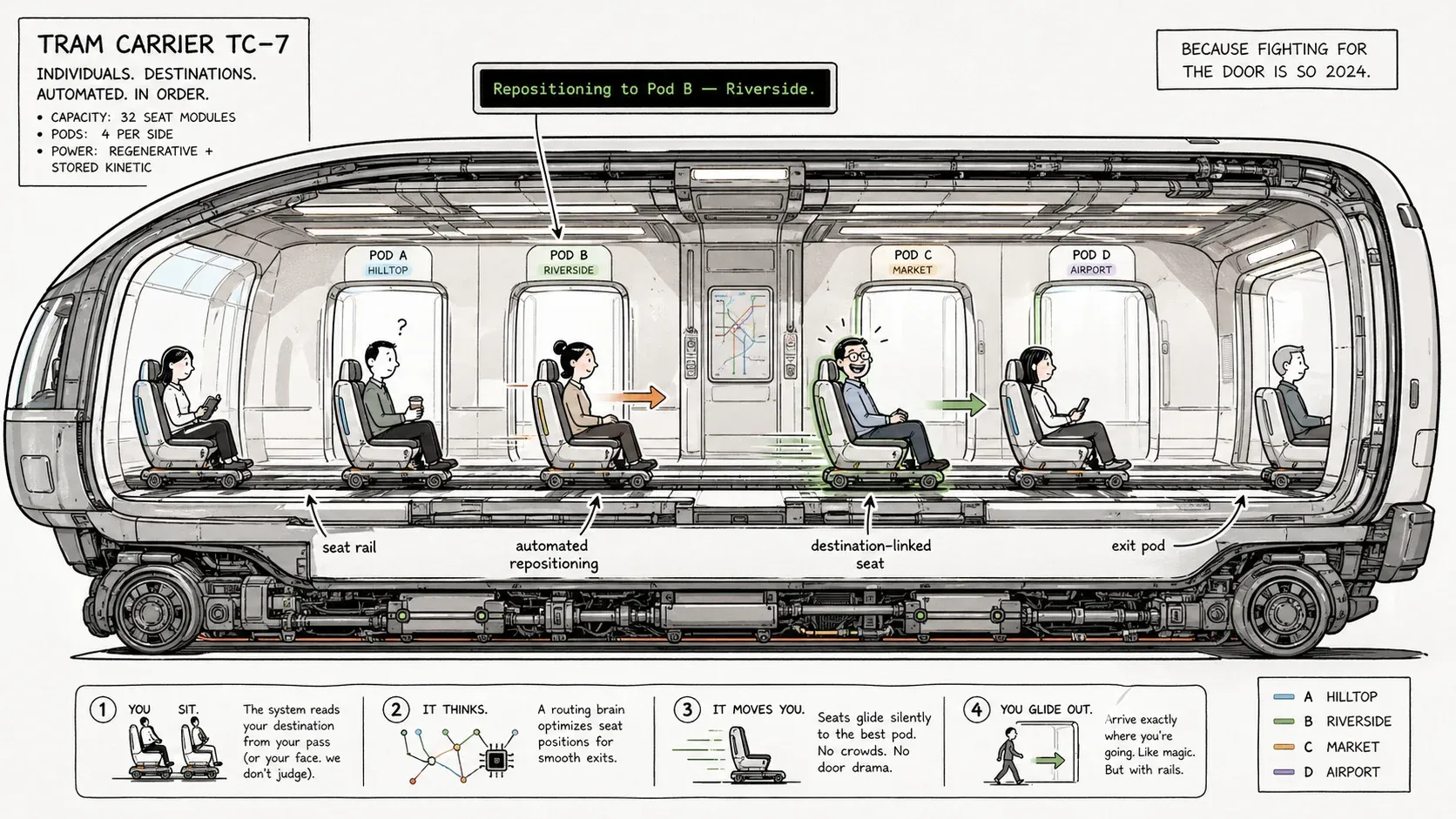
The near-term version should avoid moving seats.
The first prototype should be boring where possible.
That is the secret of successful futurism:
Make one thing magical. Make everything else aggressively normal.
The magical thing is the pod exchange.
Do not also reinvent sitting.
How the swap actually works
Let’s slow down and watch one station exchange.
Step 1: passengers choose destinations
Inside the station, passengers enter destinations using screens, phones, or simple zone gates.
The station groups them into pods.
A pod display says:
“This pod serves: Museum, University, Riverside.”
Or:
“Direct to Airport.”
Step 2: pods wait in launch bays
Pods sit in short queue lanes beside the main track.
They are not loose vehicles wandering around. They are guided, controlled, and locked into a station-side transport system.
Think less “autonomous taxi.”
Think more “horizontal elevator cabin.”
Step 3: the main carrier announces its slot map
Before it reaches the station, the carrier tells the station:
- which pod slots are occupied
- which pods will exit
- which slots will become free
- whether the vehicle is on time
- whether any slot is unavailable
- whether the exchange should proceed
This is where modern automatic train-control ideas matter. Systems like CBTC already track trains precisely and allow automated metro operation. A pod-tram would need even more detailed control, because it is coordinating not just trains but detachable sub-vehicles.[14]
Step 4: outgoing pods unlock first
The carrier slows slightly.
Pods scheduled for this station prepare to leave. Their locks are checked. The station-side deceleration lane synchronizes with them.
Outgoing pods slide out.
Not fall out.
Not get flung out like toast.
Slide out.
This must be guided by rails, rollers, magnetic guidance, or some other constrained mechanism. The design should never rely on “hoping alignment is okay.”
Step 5: incoming pods insert into free slots
Incoming pods are already traveling beside the carrier at matched speed.
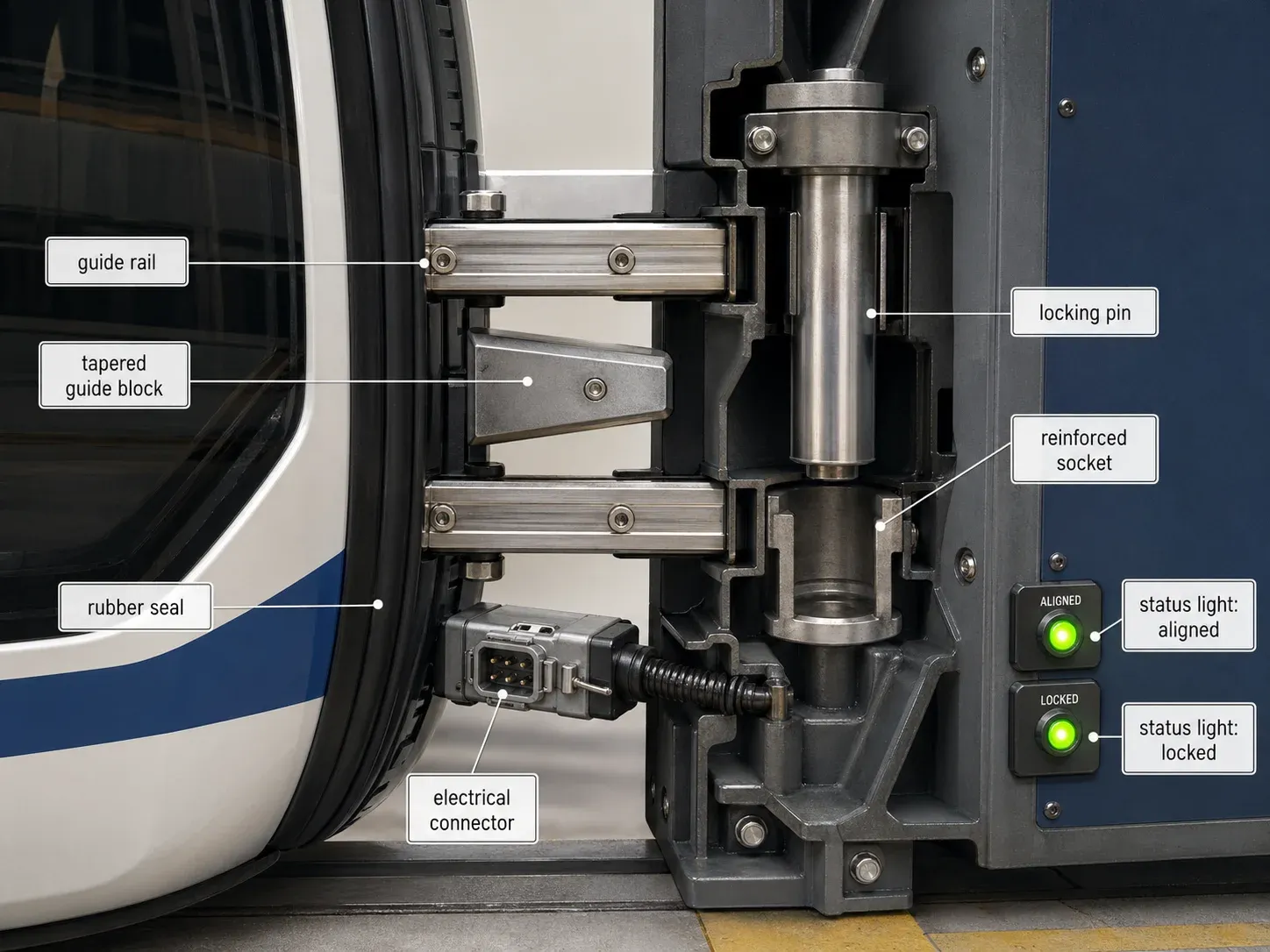
When the slot is clear and all sensors agree, the pod moves laterally into the carrier. Mechanical locks engage. Electrical and data connectors engage. The system confirms:
Pod captured.
Lock closed.
Passenger cabin secure.
If anything is wrong, the pod does not enter. It continues into an abort lane and brakes safely.
Step 6: the carrier accelerates away
The carrier returns to normal line speed.
Passengers inside barely notice, except that the pod display now says:
“Attached. Next exchange in 2 minutes.”
That is the ideal experience.
Not drama.
Not spectacle.
Just a calm little “click” in the background of your commute.
Failure must be boring
A futuristic transport system is only viable if its failures are boring.
Exciting failures are for movie trailers.
So the pod-tram needs conservative failure modes:
If an incoming pod is late
It misses the exchange and returns to the station.
The carrier continues.
Passengers wait for the next carrier.
Annoying, not catastrophic.
If an outgoing pod fails to unlock
It stays attached.
Passengers continue to the next recovery station or are rerouted.
Annoying, not catastrophic.
If a slot is not confirmed empty
No incoming pod is launched into that slot.
Annoying, not catastrophic.
If the carrier has a fault
It behaves like a conventional automated train: slow, stop in a safe area, evacuate using walkways or rescue platforms.
Annoying, not catastrophic.
This is important because the system will have many more moving parts than a normal tram. More moving parts means more ways to fail. The only acceptable answer is not “it never fails.”
The acceptable answer is:
“When it fails, it fails gracefully.”
Why ordinary couplers are not enough
It is tempting to say:
“Trains already couple. Just use train couplers.”
But ordinary rail coupling is not designed for this.
Automatic couplers are sophisticated safety-critical systems. Modern units combine mechanical locking, electrical connections, pneumatic lines, dampers, and crash-energy management. They are impressive. But they are generally designed for train-to-train coupling at low speeds, not for repeated sideways pod insertion into a moving carrier at urban line speed.[15][16]
This is one of the biggest engineering leaps.
A pod-tram needs something more like a hybrid of:
- aircraft docking tolerances
- elevator safety locks
- train coupler strength
- warehouse automation repeatability
- amusement-ride fail-safe logic
- metro signaling
Which is a very dramatic way of saying:
The click has to be perfect.
Every time.
Thousands of times per day.
In rain, ice, dust, heat, and after someone spilled a milkshake where no milkshake should ever be.
The energy story: good, but not magic
The energy argument is attractive:
Why brake and accelerate an entire heavy train just to pick up a handful of people?
A pod-tram changes the mass equation. Instead of stopping the whole carrier, you mainly accelerate and brake the smaller pods that actually exchange at that station.
That sounds like a giant energy win.
It might be a win, but the article should be honest: modern electric trains already use regenerative braking. They can recover some energy when slowing down and feed it back into the system, store it, or let nearby trains use it.[17][18]
So the pod-tram does not save all the kinetic energy of every stop.
The better energy argument is subtler:
- less full-train braking
- lower peak power demand
- less heat from braking
- less mechanical wear
- smoother traffic flow
- fewer timetable delays caused by dwell-time variation
- better average speed without raising top speed
The biggest advantage may not be raw electricity.
It may be rhythm.
Conventional transit is pulse-based:
Stop. Go. Stop. Go. Stop. Go.
A pod-tram is flow-based:
Glide. Exchange. Glide. Exchange. Glide.
Cities like flow.
Where this could actually be built first
The first pod-tram should not be placed in the middle of a century-old city tram network and asked to behave.
That would be like testing a jetpack in a kitchen.
The first version should live somewhere controlled.
Good pilot locations
Airport connector
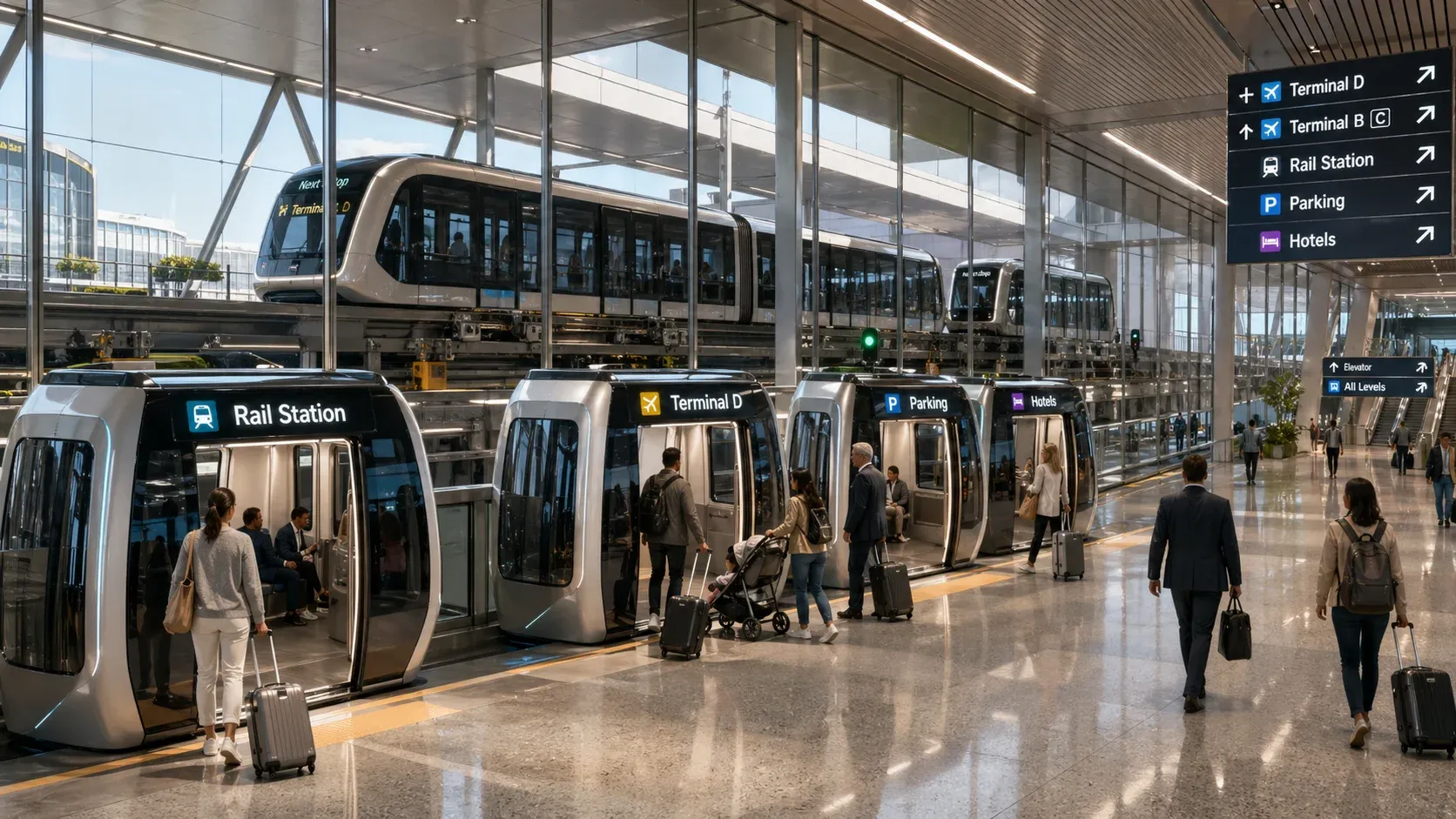
Airports already have automated people movers, controlled guideways, and passengers with luggage. A pod system could connect terminals, parking, rental cars, hotels, and rail stations.
Expo or theme-park route
High novelty tolerance. Predictable flows. Good place to test passenger behavior.
University campus
Short routes, repeated demand, tech-friendly environment, and lots of people willing to become unpaid beta testers if the thing looks cool.
New urban district
A place where the guideway, stations, evacuation routes, and pod depots can be designed from scratch.
Industrial or hospital campus
Not glamorous, but operationally useful. Predictable destinations. Controlled access.
The first route should be short. Maybe 2–5 kilometers. Five to eight stations. Moderate speed. Fully separated guideway. No street traffic. No intersections. No “surprise delivery truck parked on the pod lane.”
The goal is not to replace the metro on day one.
The goal is to prove:
A moving carrier can exchange passenger pods safely, repeatedly, and without terrifying anyone.
A possible pilot route
Let’s design a fictional one.
The setting
A large airport has four terminals, a railway station, a parking hub, and a hotel district.
Today, it uses shuttle buses and an automated people mover that stops at every terminal.
Tomorrow, it tests the Rolling Station.
The route
- Terminal A
- Terminal B
- Terminal C
- Terminal D
- Rail Station
- Parking / Rental Cars
- Hotel Zone
The vehicles
Main carriers run every 90 seconds.
Each carrier has six pod slots per side, but the pilot only uses four active slots at first.
Each pod holds eight passengers plus luggage.
The experience
You enter the station and tap:
“Rail Station.”
The system assigns Pod 12.
You enter Pod 12 with six other passengers. The doors close. The pod moves forward, accelerates, and joins the next carrier. You feel a smooth lateral motion and a soft lock.
The main carrier passes Terminal B. Your pod stays attached.
At Terminal C, two other pods exit. Two new pods enter.
At the Rail Station, your pod slides out, brakes into the arrival bay, and opens.
You never stood on a crowded train.
You never worried about missing the stop.
The train never stopped.
For an airport, this is not just faster. It is psychologically cleaner.
Airports are already stressful enough. Anything that removes the “wait, is this my stop?” moment is a small act of mercy.
The long-term city version
If the airport version works, the city version becomes interesting.
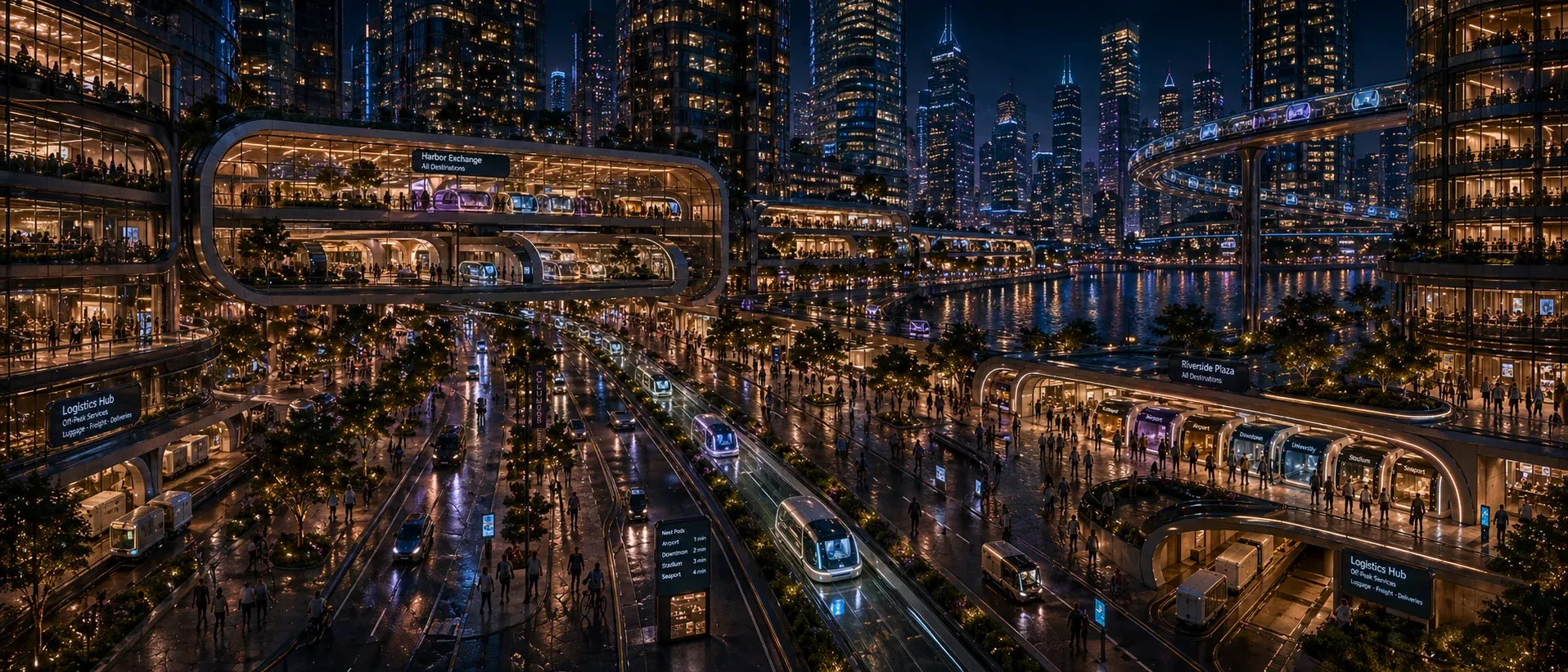
Imagine a tram line where major stops are no longer stops in the old sense. They are pod-exchange nodes.
The main carrier might run continuously along a central corridor. Local stations feed pods into it.
Some pods are short-hop.
Some are express.
Some serve only popular destinations.
Some are reserved for mobility needs.
Some carry bikes or strollers.
Some are freight pods at night.
That last bit matters.
A city pod-tram could become a mixed passenger-and-logistics system:
- commuters by day
- parcels at off-peak hours
- medical supplies on priority routes
- airport luggage
- event crowd management
- late-night low-demand pods instead of empty full trains
The carrier does not care whether the pod contains eight people, six suitcases, or a crate of hospital linens.
The city gets a moving backbone.
The pods become programmable payloads.
This is where the idea starts feeling less like “a better tram” and more like urban packet switching.
The internet sends packets through networks.
A pod-tram sends passenger packets through a city.
That sentence is both exciting and mildly dystopian, which means it is probably a decent future-tech sentence.
The high-speed dream
Now let’s return to the seductive fantasy: high-speed trains that never stop.
It is still possible to imagine.
A high-speed train races across the country. Instead of stopping at every medium-sized city, it passes through long exchange corridors outside urban centers. Regional feeder pods or tram-like transfer vehicles accelerate alongside it. Passengers join and leave without the main train stopping.
This would make the railway network feel less like a chain of stops and more like a bloodstream.
But this is the long-term version for a reason.
At high speed, the system must solve:
- multi-kilometer exchange lanes
- aerodynamic pressure waves
- emergency evacuation far from platforms
- extremely precise alignment
- high-speed switching
- crashworthiness
- certification
- public trust
The public-trust part is underrated.
People will accept a new app.
People will accept automatic doors.
People may even accept driverless trains.
But telling people:
“Your cabin will now attach to a train moving at 300 km/h”
requires a special kind of confidence.
The high-speed version might come someday. But the urban version should come first.
Make it normal at 50 km/h.
Then talk about 160.
Then, perhaps, 300.
The future should be allowed to pass its driving test before entering Formula 1.
The design principle: one miracle only
A lot of futuristic transport concepts fail because they stack miracles.
They require:
- new vehicles
- new tracks
- new stations
- new passenger behavior
- new safety standards
- new economics
- new politics
- and maybe a new material invented by optimistic render artists
The pod-tram should avoid this trap.
It should choose one miracle:
Pods exchange with a moving carrier.
Everything else should be as boring as possible.
- steel wheels or proven guideway tech
- modest speeds
- enclosed stations
- conventional emergency walkways
- familiar seating
- clear signage
- simple destination selection
- human-scale cabins
- conservative operating rules
That is how wild ideas survive contact with reality.
The first airplane did not have in-flight Wi-Fi.
The first pod-tram does not need moving seats.
What the idea reveals
At first glance, the non-stop tram seems like a mechanical idea.
How do we move the pod?
How do we lock it in?
How fast can it go?
But the deeper question is operational:
How do we make the system understandable enough that normal people can use it while half-awake on a Tuesday?
That is the real test.
A successful pod-tram would need to feel less like boarding a spaceship and more like using an elevator.
You select where you are going.
You step into the assigned cabin.
The system does the rest.
No timetable anxiety.
No missed stop.
No crowding at the doors.
No “please move down inside the vehicle” announcement slowly eroding your soul.
The best version is not one where passengers marvel at the technology every day.
The best version is one where they stop noticing it.
A commuter walks into a pod. The pod joins the tram. The tram glides through the city. The pod exits at the right station.
And somewhere, deep in the infrastructure, a machine does something astonishing thousands of times per day.
Click.
Click.
Click.
A city that used to stop starts flowing.
Sources
Christoforou, Zoi; Chandakas, Ektoras; Kaparias, Ioannis, 2020. Investigating the Impact of Dwell Time on the Reliability of Urban Light Rail Operations. Urban Rail Transit. https://doi.org/10.1007/s40864-020-00128-1. Accessed 28 April 2026. ↩︎
Kuipers, Ruben Alaric; Palmqvist, Carl-William, 2022. Passenger Volumes and Dwell Times for Commuter Trains: A Case Study Using Automatic Passenger Count Data in Stockholm. Applied Sciences. DOI: 10.3390/app12125983. https://www.mdpi.com/2076-3417/12/12/5983. Accessed 28 April 2026. ↩︎
LEITNER, n.d. Detachable Gondola Lifts. LEITNER ropeways. https://www.leitner.com/en/products/ropeway-systems/detail/detachable-gondola-lifts/. Accessed 28 April 2026. ↩︎
STRMTG, 2023. Gondola Lift — Continuous Movement Unidirectional Aerial Ropeway. Service Technique des Remontées Mécaniques et des Transports Guidés. https://www.strmtg.developpement-durable.gouv.fr/en/gondola-lift-continuous-movement-unidirectional-a132.html. Accessed 28 April 2026. ↩︎
United States Federal Railroad Administration, 2003. Aerodynamic Effects of High-Speed Trains. Federal Railroad Administration, Report RR03-07. https://rosap.ntl.bts.gov/view/dot/40510. Accessed 28 April 2026. ↩︎
Derkowski, Paul; Clark, Steve; Sturt, Richard; Keylin, Alexander; Baker, Chris; Vardy, Alan; Wilson, Nicholas, 2015. High-Speed Rail Aerodynamic Assessment and Mitigation Report. Federal Railroad Administration, DOT/FRA/ORD-15/40. https://railroads.dot.gov/sites/fra.dot.gov/files/fra_net/15563/TR_High-Speed_Rail_Aero_Assessment_final.pdf. Accessed 28 April 2026. ↩︎
Nold, Michael; Corman, Francesco, 2021. Dynamic Train Unit Coupling and Decoupling at Cruising Speed: Systematic Classification, Operational Potentials, and Research Agenda. Journal of Rail Transport Planning & Management. DOI: 10.1016/j.jrtpm.2021.100241. https://www.sciencedirect.com/science/article/pii/S2210970621000081. Accessed 28 April 2026. ↩︎
Europe’s Rail Joint Undertaking, n.d. Pods4Rail. Europe’s Rail. https://rail-research.europa.eu/rail-projects/pods4rail/. Accessed 28 April 2026. ↩︎
Nguyen, Tuan C., 2013. This High-Speed Train Picks Up Passengers Without Having to Stop. Smithsonian Magazine. https://www.smithsonianmag.com/innovation/this-high-speed-train-picks-up-passengers-without-having-to-stop-180948281/. Accessed 28 April 2026. ↩︎
Platts, Linda, 2010. The Train That Does Not Stop. Property and Environment Research Center. https://perc.org/2010/10/04/the-train-that-does-not-stop/. Accessed 28 April 2026. ↩︎
PriestmanGoode, 2011. Britain’s Leading Transport Designer Unveils the Future for 21st Century Train Travel. PriestmanGoode press release. https://move-nl.com/wp-content/uploads/2016/09/PG-Moving-Platforms-Press-Release.pdf. Accessed 28 April 2026. ↩︎
TK Elevator, n.d. What Is Destination Dispatch? TK Elevator. https://www.tkelevator.com/us-en/company/insights/what-is-destination-dispatch.html. Accessed 28 April 2026. ↩︎
Deutsche Bahn AG, n.d. Automatisierte Sitzsysteme. Ideenzug. https://ideenzug.deutschebahn.com/komponentenkatalog/Automatisierte-Sitzsysteme-8804518. Accessed 28 April 2026. ↩︎
Alstom, n.d. Communications-Based Train Control: World Leading High-Capacity Signalling. Alstom. https://www.alstom.com/solutions/signalling/urban-signalling/communications-based-train-control-world-leading-high-capacity-signalling. Accessed 28 April 2026. ↩︎
Knorr-Bremse, n.d. Train Couplers: Automated Solutions. Knorr-Bremse Rail Systems. https://rail.knorr-bremse.com/en/de/portfolio/products-and-systems/automatic-coupling-solutions/. Accessed 28 April 2026. ↩︎
Dellner, n.d. Automatic Coupler Type 10. Dellner. https://www.dellner.com/products/automatic-couplers/automatic-coupler-type-10. Accessed 28 April 2026. ↩︎
González-Gil, Arturo; Palacin, Roberto; Batty, Paul, 2013. Sustainable Urban Rail Systems: Strategies and Technologies for Optimal Management of Regenerative Braking Energy. Energy Conversion and Management. DOI: 10.1016/j.enconman.2013.06.039. https://www.sciencedirect.com/science/article/abs/pii/S0196890413003518. Accessed 28 April 2026. ↩︎
Falvo, Maria Carmen; Sbordone, Danilo; Fernández-Cardador, Antonio; Cucala, Asunción P.; Pecharromán, Ramón R.; López-López, Alvaro, 2016. Energy Savings in Metro-Transit Systems: A Comparison Between Operational Italian and Spanish Lines. Proceedings of the Institution of Mechanical Engineers, Part F: Journal of Rail and Rapid Transit. https://doi.org/10.1177/0954409714542276. Accessed 28 April 2026. ↩︎